
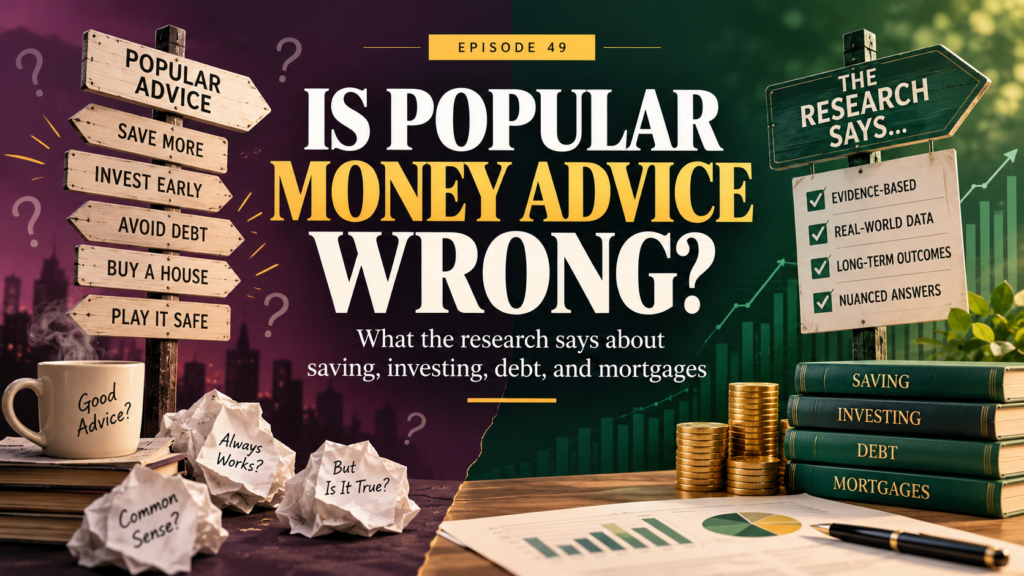
Save 10–15% of your income. Reduce stock exposure as you age. Buy dividend-paying stocks. Pay off your smallest debt first. Choose a fixed-rate mortgage.
These rules are repeated often—but are they right for everyone?
In Episode 49 of Plain English Finance, Sierra and I discuss research comparing popular financial advice with economic theory. A useful starting point is Yale professor James Choi’s paper, Popular Personal Financial Advice versus the Professors.
The central distinction is between advice that’s easy to follow and advice that’s financially appropriate for your circumstances.
Should You Save 10–15% of Your Income?
A fixed savings percentage is simple, but it ignores how income and financial responsibilities change across a lifetime. A young professional and someone at peak earnings may need very different savings rates.
What research suggests
Economists describe consumption smoothing: aiming for a relatively stable standard of living over time, even as income changes. That can mean saving less in low-income years and more in high-income years—provided the long-term plan remains viable.
My approach
Don’t automatically increase your lifestyle whenever income rises. Decide what level of spending supports your goals, then direct excess income toward savings, investments or debt reduction. A 10% savings rate can be a useful starting point, but it isn’t a universal target.
Should Your Investments Become More Conservative as You Age?
Age matters, but it’s not the only factor affecting investment risk. Spending needs, pensions, future employment income and financial flexibility matter too.
What research suggests
Economic models consider human capital—the value of future earning potential—alongside financial investments. They also consider when money must be spent and the consequences of investment losses.
My approach
Match investments to their purpose and time horizon. A retiree relying on portfolio withdrawals and one whose pension covers most expenses can have very different needs despite being the same age. Near-term spending money generally belongs in more stable assets, while longer-term capital may be able to withstand greater volatility.
Are Dividend Stocks the Best Source of Investment Income?
Regular dividends can feel reassuring, especially in retirement. But a dividend is not a bonus return on top of the company’s value.
What research suggests
When a company distributes cash, that money leaves the business. Investors should focus on total return—price changes plus distributions—rather than dividend yield alone.
My approach
Consider diversification, costs and total after-tax returns. Canadian dividends and capital gains receive different tax treatment, and the best result depends on the investor’s circumstances and account type. The analysis can be especially important for investments held through a corporation.
Index Funds or Active Management?
Broadly diversified, low-cost index investing is one area where much popular guidance aligns with academic evidence.
What research suggests
Active managers may outperform, but identifying future winners consistently—after fees and trading costs—is difficult. Past outperformance does not reliably predict future outperformance.
My approach
Use cost-conscious, diversified investments built around sound economic principles rather than trying to forecast the next winning stock or fund manager. The goal is a portfolio that is appropriate and sustainable, not necessarily exciting.
What’s the Best Way to Repay Debt?
The snowball strategy repays the smallest balance first; the avalanche strategy targets the highest interest rate first.
What research suggests
All else equal, prioritizing the highest-interest debt generally minimizes total interest costs.
My approach
Recognize the behavioural trade-off. Clearing small balances may help some people stay motivated. That can be worthwhile, but be clear that the snowball approach may cost more in interest. A repayment strategy needs both sound mathematics and a realistic chance of being followed.
Is a Fixed-Rate Mortgage Always the Safest Choice?
Fixed-rate mortgages offer interest-rate certainty during their term. Variable-rate mortgages expose borrowers to rate changes, although payment structures can differ.
What research suggests
Some theoretical models favour adjustable-rate borrowing under specific assumptions. That does not make variable rates universally preferable.
My approach
Ask what happens if the decision goes against you. Could your household manage higher payments without disrupting essential spending or forcing investment sales? In Canada, even fixed-rate mortgages commonly renew before the amortization is complete. Choose based on cash-flow resilience, mortgage terms and risk—not certainty about future interest rates.
The Bigger Lesson: Rules Are Starting Points, Not Financial Plans
Popular advice is often designed to be memorable and actionable. Academic frameworks offer a way to examine its assumptions, but they too have limitations. What matters is understanding why a strategy works, what it costs, and how it fits your actual circumstances.
Before following a money rule, ask what evidence supports it, what assumptions it makes, how tax and cash flow affect the outcome, and whether you can stick with it when circumstances change.
Listen to Episode 49
Plain English Finance: Popular Money Advice vs. What the Research Says
Listen to the episode and view the transcript.
Research Referenced
James J. Choi, Popular Personal Financial Advice versus the Professors (2022). Read the research paper.
About the author: Tré Bynoe, CFP®, CIM®, is a Financial Planner with TCU Wealth Management in Saskatoon, Saskatchewan, focusing on corporate wealth planning, retirement income, and tax-efficient investments.
This article is for general education and is not personalized investment, tax or legal advice. Financial decisions should be evaluated in light of individual circumstances and applicable disclosures.